

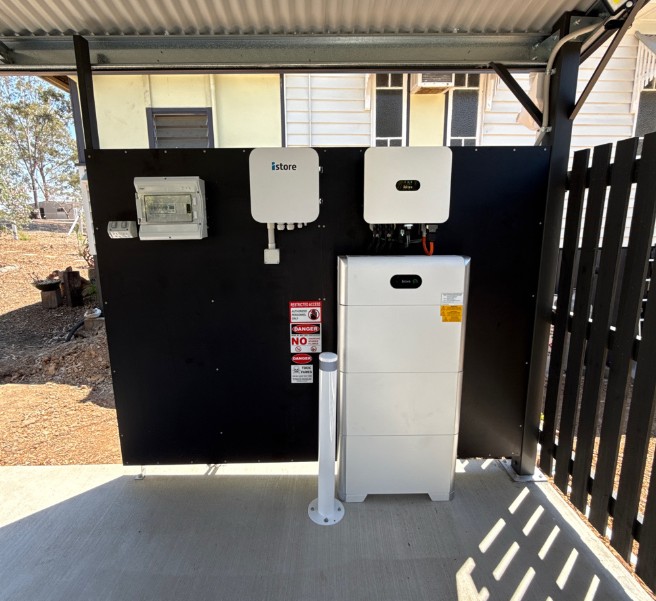
Short answer: A 10 kWh home battery costs about $7,800 installed in 2026, after the federal battery discount. A 20 kWh battery is about $15,000. Before the discount, a 10 kWh battery works out to roughly $10,000 to $10,500.
Those are national averages. Your price in Brisbane depends on the battery brand, whether you need a new inverter, and how easy your home is to wire. This guide explains what changes the price and how to work out if a battery will pay for itself.
Typical battery prices in 2026
Solar Choice tracks installed battery prices across Australia every month. Its August 2026 averages, including installation, GST and the federal discount, were:
- 10 kWh battery: about $7,800 (or about $8,300 with a new inverter)
- 20 kWh battery: about $15,000 (or about $15,800 with a new inverter)
- 30 kWh battery: about $22,500 (or about $23,100 with a new inverter)
That works out to roughly $750 to $830 per kWh of storage. Larger batteries are not much cheaper per kWh, partly because the federal discount gives less support above 14 kWh.
Prices for popular battery brands
SolarQuotes publishes typical prices for the batteries Australians buy most. Its May 2026 figures, after the federal discount:
- Sungrow SBR 12.8 kWh: about $8,100 to $8,800
- Sigenergy SigenStor 13 kWh: about $8,000 to $9,300
- BYD HVM 13.8 kWh: about $8,100
- Tesla Powerwall 3 (13.5 kWh): about $10,000
Treat these as a guide only. Prices change often, and the federal discount itself drops on 1 January 2027. A written quote for your home is the only number that counts.
What changes the price of a battery?
- Battery size. More storage costs more, though not in a straight line.
- Inverter. Some homes can connect a battery to their existing solar. Others need a new hybrid inverter or a battery with its own inverter built in.
- Blackout backup. If you want the battery to keep the lights on during an outage, it needs extra wiring and a backup circuit. Not every system can do this.
- Switchboard. Older Brisbane homes sometimes need a switchboard upgrade before a battery can go in.
- Location. A short, simple cable run is cheaper than a battery on the far side of the house.
- Single or three phase. Three-phase homes have more options but can cost more to connect.
What size battery does a Brisbane home need?
Start with how much power you use after the sun goes down. Most of the value of a battery comes from covering your evening and overnight usage with solar you stored during the day.
In Brisbane, each kW of solar panels makes about 4.2 kWh a day on average across the year. A 6.6 kW system makes about 28 kWh a day, which is often more than the home uses while the sun is up. That spare power is what fills the battery.
For many homes, a battery of around 10 to 14 kWh is the sweet spot. It covers a typical evening, and it sits inside the size range that gets the full federal discount. Bigger families, pool owners and homes with an electric car may need more.
Will a battery pay for itself?
A battery saves money by replacing power you would otherwise buy from the grid at night. The saving is roughly:
kWh you shift each day × (what you pay for power at night − the feed-in tariff you give up)
Here is a simple example with round numbers. Say you shift 8 kWh a night, you pay 32 cents per kWh at night, and your retailer would have paid you 4 cents to export that power. That is 8 × 28 cents, or $2.24 a day. Over a year that is about $820.
Your own numbers will be different. Things that make a battery pay off faster:
- High evening usage, such as cooking, air conditioning and pool pumps
- A time-of-use plan with expensive evening rates (Energex's standard time-of-use network tariff has its peak from 4pm to 9pm)
- A low feed-in tariff, which is now normal across South East Queensland
- Joining a virtual power plant, which can pay you extra for letting the battery help the grid
SolarQuotes lists Queensland among the states where a good battery can pay for itself within its warranty period. Our guide to feed-in tariffs in South East Queensland explains why exporting solar now earns so little.
When is the best time to buy?
The federal discount is currently at its 2026 rate, and it steps down again on 1 January 2027. On a 10 kWh battery that cut is worth about $420. Read our guide to the battery rebate in Queensland for the full schedule.
Get a fixed battery quote for your home
Every home is different, so the best way to get a real number is a written quote. Renewlec looks at how you use power, your existing solar and your switchboard, then quotes with the federal discount already taken off. Our in-house electricians install brands including Sungrow, Sigenergy and Tesla across Brisbane.
See our solar battery installation page, or contact us to book a free site assessment.